Wholesale Consolidation: Many Suppliers, One Container
The operating process behind the most useful trick in wholesale importing — collecting goods from several Chinese factories into one full container under one bill of lading, instead of paying for partial boxes or staggered groupage sailings.
Buyer's consolidation collects your POs from multiple suppliers into one warehouse, inspects and tallies them, then stuffs a single FCL container consigned to you — one seal, one entry, one drayage at destination. It differs from LCL groupage (where several consignees share a box) and from raw multi-drop FCL (where a stuffed container truck is routed factory-to-factory, which works only for suppliers within drayage distance of each other).
The economics are structural: an LCL shipment pays per-CBM ocean plus destination CFS deconsolidation; your own consolidated FCL pays one box rate plus terminal drayage. When your combined volume models near two-thirds of a 20GP's usable cube, consolidation into your own box is usually the cheaper and safer structure.
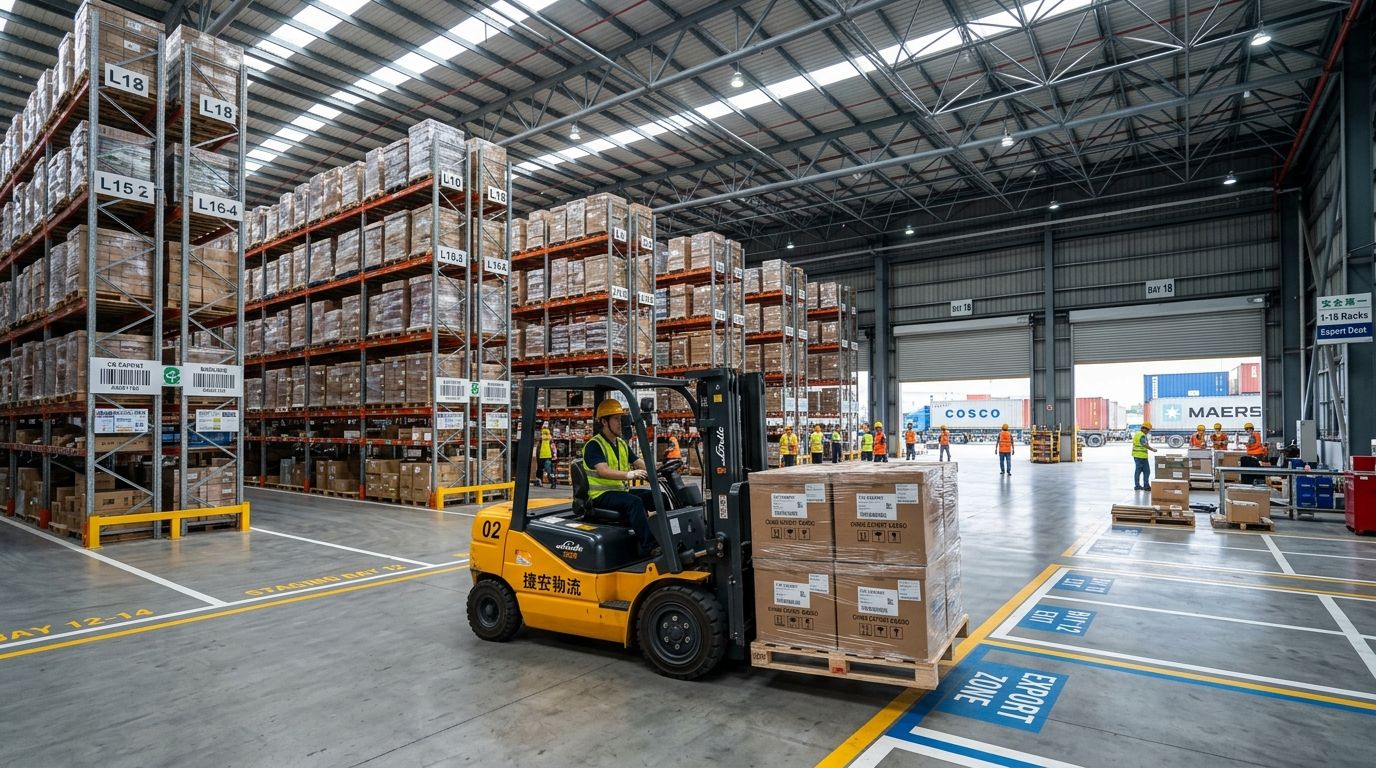
From Purchase Orders to a Stuffed Container
Consolidation is a scheduling discipline more than anything else. The vessel is chosen against the slowest supplier’s cargo-ready date, and every step below exists to protect that vessel: goods must be measured, checked, and plan-ready before the truck arrives for stuffing day.
Consolidation vs groupage, in one line
Groupage shares a box between consignees and splits the destination CFS fees; consolidation gives the whole box to one buyer and deletes the deconsolidation step. Both collect from multiple suppliers — only one ships on your schedule.
| Stage | What Happens | Documents Produced | Typical Span |
|---|---|---|---|
| 1. Booking intake and supplier map | Open the shipment with a PO-level supplier list: factory locations, carton counts, volumes, and cargo-ready dates per supplier. The booking desk converts it into a pickup plan and a target vessel with cut-off dates. | PO list, packing lists, booking request | Day 0–2 |
| 2. Pickup scheduling | Trucks are dispatched per supplier against cargo-ready dates, each collecting against a numbered delivery order so receiving staff can match arriving goods to the right PO. | Delivery orders, freight receipts | Per supplier ready date |
| 3. CFS receiving and tally | Goods are checked in at the consolidation warehouse: cartons counted against packing lists, shipping marks photographed, visible damage recorded, and volumes tallied so the load plan uses measured numbers, not supplier estimates. | Receiving tally report, damage photos | Same day as arrival |
| 4. Quality inspection | Where inspection is scoped, AQL sampling and the loading survey happen while goods are still in the warehouse — the only point where rejected lots can be quarantined without derailing the vessel. | Inspection report, rework notes | Before stuffing |
| 5. Load planning | Measured cartons are arranged into a stuffing plan: floor-loaded or palletized, heavy goods low and evenly spread across the floor area, and high-value cartons placed away from the doors. | Load plan, container photos | 1 day before stuffing |
| 6. Stuffing and sealing | The container is stuffed to the plan, lashed where needed, weighed for VGM, sealed, and the seal number recorded against the B/L instruction — one seal, one box, one importer. | VGM, seal record, loading photos | Stuffing day |
| 7. Export customs and gate-in | The export declaration is filed and the laden container gates into the CY before terminal cut-off, converting the plan into a sailing. | Customs declaration, gate-in receipt | Before CY cut-off |
| 8. Documentation release | B/L is drafted from the consolidated packing data and issued after sailing; the whole shipment then follows standard FCL milestones through arrival and clearance. | Bill of lading, manifest | Post-sailing |
Spans are typical working durations and are compressed or extended by supplier readiness and the vessel calendar; confirm the actual schedule per shipment.
Where Consolidations Succeed or Stall
Storage windows. Consolidation warehouses work on a receiving window — goods arriving earliest wait longest, and storage beyond the agreed window bills per day. The efficient pattern is to sequence pickups so slow-supplier goods arrive last, keeping total warehouse time short. The window itself is set per shipment against the vessel calendar, not by a fixed tariff.
The straggler problem. One late supplier either delays the box or ships short — decide the rule before it happens: the standing options are to hold the container for the straggler, cut the straggler into LCL, or stuff short and accept a lower fill rate. Each is legitimate; the mistake is deciding after the truck is booked.
Measurement discipline. Supplier-declared CBM is a marketing document. The warehouse tally is the number that buys the container: overstated cartons at stuffing time are how “28 CBM” consignments turn into two boxes. Run the container fill planner on declared figures first, then re-check against the tally before the equipment release.
Customs shape. Consolidated boxes typically file export declarations per supplier at origin (matching each factory’s commercial facts), then sail under one B/L. At destination the import entry is yours, covering the whole box — the mechanics are covered in the export customs and destination clearance pages.
Checklist Before You Book a Consolidation
- ▸ Every supplier has a factory address, carton count, and a realistic cargo-ready date.
- ▸ Declared CBM and weight per supplier are modeled against a target box (plus 10% tolerance for tally drift).
- ▸ The slowest supplier is identified and the vessel is booked to that supplier, not to the fastest.
- ▸ Inspection scope is decided before pickups start — at the warehouse, not after stuffing.
- ▸ A straggler rule is agreed: hold, split to LCL, or stuff short.
- ▸ Destination free time matches your DC receiving calendar before the box is sealed.
Frequently Asked Questions
How long can goods wait at the consolidation warehouse?
Receiving windows are set per shipment against the vessel calendar, and storage beyond the agreed window is billed per day per pallet or CBM. Practically, the sequence that minimizes cost is staging pickups so the earliest-ready suppliers arrive closest to the cut-off; when readiness dates spread across many weeks, the better question is whether the program should split into two boxes instead of one long-storage consolidation.
What happens if one supplier misses the cut-off?
Apply the straggler rule chosen at booking: hold the whole box for the late goods (cheapest if the vessel calendar allows), split the late PO into an LCL or next-vessel shipment (keeps the main box on schedule), or stuff short and accept the lower fill. What you never want is an unplanned decision under cut-off pressure — agree the rule when the booking is placed.
Does consolidation change my import entry at destination?
It simplifies it. Because the box is consigned to one importer, destination clearance is a single entry covering the whole container, with each supplier's invoice lines inside it — no CFS deconsolidation, no per-consignment handling fees. The entry does carry a duty of accuracy across every line item, so invoice and packing data must reconcile to the warehouse tally.
Request Commercial Ocean Freight RFQ
Submit your container shipment details to our Ningbo port desk for contracted space and spot carrier pricing within 12 hours.
Last reviewed: September 2026 — consolidation windows, storage terms, and schedules are confirmed per shipment.